
Swachh Bharat Abhiyaan - Garbage Bin Design
I did a usability study on the Swachhta Pledge launched by Govt Of India under the Swachh Bharat Abhiyaan mission. The study was for the digital pledge platform but from my user interviews it turned out there were key learnings that could be used to design garbage bins that could nudge users to throw their garbage responsibly.
One such learning that I came across was this:
They themselves didn't find their beliefs aligned with the proposed campaign, but since they were observing such a mass behaviour, they joined in too.
Design strategy derived from the insights
I tried to put together two principles together in the proposed design :
- Ingroup Bias: Ingroup bias is a psychological tendency to favour members of one's own group over members of other groups. It is the tendency to view one's own group as superior to other groups and to identify with and defend one's own group, even when doing so is unjustified or harmful to others outside of the group. Ingroup bias can have both positive and negative effects.
On the positive side, it can promote a sense of shared identity and values among members of the group.
This shared identity can help create a sense of unity and common purpose, which can lead to greater cooperation and coordination.
On the negative side, ingroup bias can lead to discrimination and prejudice against members of other groups. It can create a sense of us-versus-them mentality, which can contribute to conflict and hostility between groups.
How I used it : I leveraged on the positive ingroup bias. Using the term “Us” or “Our” creates a sense of shared collective identity for those who use the dustbin and helps me as a designer, to align the users of the bin on one side of a community. This sense of belonging together increases the social cohesiveness and their tendency to act responsible for the community they belong to.
- Anchoring : Anchoring is a cognitive bias that describes the tendency for people to rely too heavily on the first piece of information they receive (the "anchor") when making decisions or judgments. This initial information then influences their subsequent thoughts and decisions, even if the information is not relevant to the decision at hand. In the context of design, anchoring can be used to nudge users towards a particular behaviour or action by presenting a clear and specific target or goal. This can help users feel motivated to reach the goal, as well as provide a sense of progress and accomplishment when the goal is achieved.
How I used it : I used anchoring to nudge the users to a goal target of yesterday’s collection. This gamifies the act of throwing garbage with a clearly displayed target where the community has to beat that target.
Design
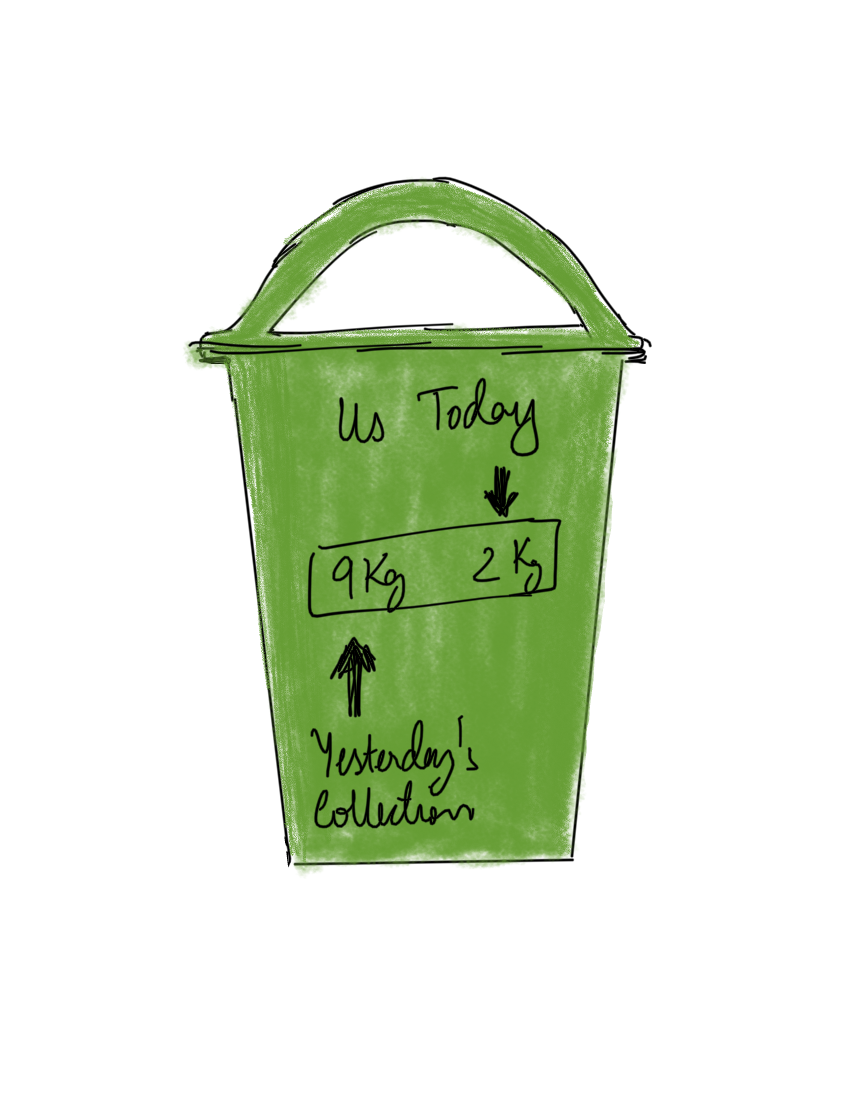
The proposed design is based on insights from real people and leverages principles from social as well as individual cognition. It can further be applied to design other behaviour change interventions. As a designer, I am excited to use these insights to create products that not only meet user needs but also nudge them towards responsible behaviour.
Overall projected experience of the bin
By combining these principles, the proposed design would create a sense of community and shared identity among users, making them more likely to throw garbage responsibly. The garbage bin would display a target amount, and users could see how much garbage has been collected so far. By beating the target amount, users would feel a sense of achievement and belonging to the community of responsible garbage throwers.